



P2Y Receptor
P2Y receptors are a class of G protein-coupled receptors (GPCRs) activated by extracellular nucleotides (ATP, UTP, and UDP). There are eight mammalian P2Y receptor subtypes (P2Y1, P2Y2, P2Y4, P2Y6, P2Y11, P2Y12, P2Y13, and P2Y14). The P2Y receptors are expressed in various cell types and play important roles in physiology and pathophysiology including inflammatory responses and neuropathic pain.
The P2Y family can be further divided into a subfamily of five P2Y1, P2Y2, P2Y4, P2Y6, and P2Y11Rs (“P2Y1-like”) that stimulate phospholipase C (PLC) through Gq protein and a second subfamily of P2Y12, P2Y13, and P2Y14Rs (“P2Y12-like”) that inhibit adenylate cyclase through Gi protein. Other effector pathways have been documented, such as coupling of the P2Y11R to Gs as well as to Gq in some cells to induce stimulation of cyclic AMP production.
P2Y Receptor Isoform Specific Products
All Product Categories
-
P2Y Receptor Inhibitors
(58)
View all products
-
P2Y Receptor Agonists
(50)
View all products
-
P2Y Receptor Antagonists
(85)
View all products
-
P2Y Receptor Activators
(11)
View all products
-
P2Y Receptor Modulators
(4)
View all products
-
P2Y Receptor Controls
(3)
View all products
-
P2Y Receptor Ligands
(3)
View all products
-
P2Y Receptor Related Products (229)
Related Products (229)

-
Antibodies (2)
-
P2Y Receptor Isoform Comparison
-
P2ry14 Mouse Pre-designed siRNA Set A
 0 ImagesCat. No.: HY-RS09926
P2ry14 Mouse Pre-designed siRNA Set A contains three designed siRNAs for P2ry14 gene (Mouse), as well as a negative control, a positive control, and a FAM-labeled negative control.
-
SAR216471
 0 ImagesCat. No.: HY-12435CAS No.: 1279867-21-8SAR216471 is a P2Y12 receptor antagonist. SAR216471 reversibly blocks the binding of 2MeSADP to P2Y12 receptors in vitro with an IC50 of 17 nM. SAR216471 can result in the inhibition of platelet aggregation. SAR216471 exhibits anti-thrombotic activity in rat model. SAR216471 can be studied in research on thrombosis.
-
Evategrel
 0 ImagesCat. No.: HY-159839CAS No.: 2760609-74-1Synonyms: CG-0255Evategrel is a platelet aggregation inhibitor.
-
Rp-UTP-α-S tetrasodium
 0 ImagesCat. No.: HY-137612CSynonyms: Rp-Uridine 5'-O-1-thiotriphosphate tetrasodiumRp-UTP-α-S (Rp-Uridine 5'-O-(1-thiotriphosphate)) tetrasodium is a nucleotide agonist of purinergic P2Y2 and P2Y4 receptors. Rp-UTP-α-S (tetrasodium) can induce inositol phosphate accumulation in P2Y2 or P2Y4 expressing 1321N1 cells with EC50 values of 5.4 and 27 μM.
-
ADP-β-S trisodium
 0 ImagesCat. No.: HY-134353ASynonyms: Adenosine 5'-(β-thiodiphosphate) trisodiumADP-β-S (Adenosine 5'-(β-thiodiphosphate)) trilithium is a non-hydrolyzable ADP analog and a P2Y12 receptor agonist. ADP-β-S trilithium activates the P2Y12 receptor in microglia, thereby triggering downstream inflammatory signaling pathways. ADP-β-S trilithium activates P2Y purinergic receptors in rat pancreatic β cells and enhances glucose-induced insulin secretion. ADP-β-S trilithium can be used in the research of diseases such as inflammation and diabetes.

-
Prasugrel-d4
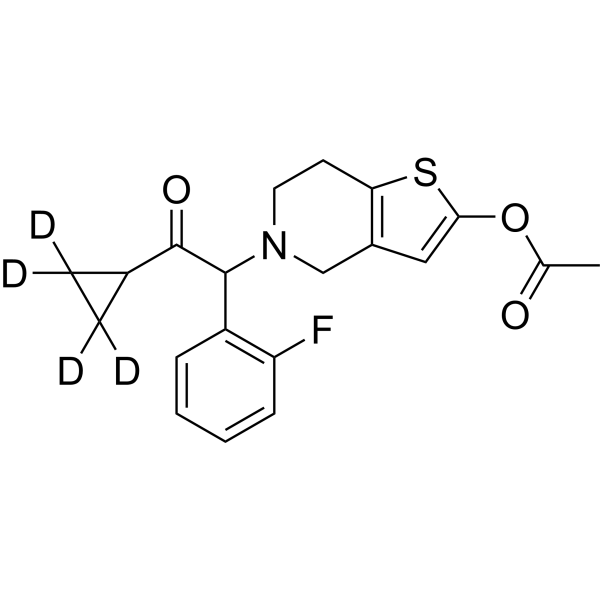 0 ImagesCat. No.: HY-15284S2CAS No.: 1189919-49-0Synonyms: PCR 4099-d4Prasugrel-d4 is the deuterium labeled Prasugrel. Prasugrel (PCR 4099), a thienopyridine and proagent, inhibits platelet function. Prasugrel is an orally active and potent P2Y12 receptor antagonist, and inhibits ADP-induced platelet aggregation.
-
P2Y1/P2Y6 antagonist 1
 0 ImagesCat. No.: HY-176143P2Y1/P2Y6 antagonist 1 (Compound 3h) is an indolesulfonylhydrazide derivative. P2Y1/P2Y6 antagonist 1 is an orally active tP2Y1 and rP2Y6 antagonist (IC50 of 9.72 and 1.89 μM, respectively). P2Y1/P2Y6 antagonist 1 can be used in the study of neurological diseases, inflammation, cardiovascular diseases and cancer.
-
PSB 0474
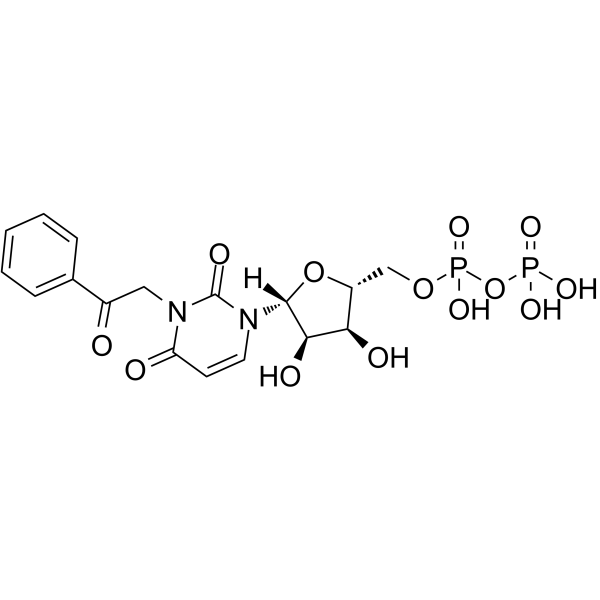 0 ImagesCat. No.: HY-108654CAS No.: 917567-60-3PSB 0474 (3-phenacyl-UDP) is a UDP (HY-113359) analog and selective P2Y6 receptor agonist, with an EC50 value of 70 nM for the hP2Y6 receptor. PSB 0474 activates Phospholipase C-coupled receptors to increase intracellular inositol phosphate levels. PSB 0474 enhances NO release by upregulating inducible iNOS and induces Apoptosis. PSB 0474 increases micturition frequency in urine of anesthetized rats, without altering bladder contraction amplitude/duration or causing urothelial damage. PSB 0474 can be used in studies related to chronic brain inflammation.
-
P2ry1 Rat Pre-designed siRNA Set A
 0 ImagesCat. No.: HY-RS09916
P2ry1 Rat Pre-designed siRNA Set A contains three designed siRNAs for P2ry1 gene (Rat), as well as a negative control, a positive control, and a FAM-labeled negative control.
-
MRS2693 ammonium
 0 ImagesCat. No.: HY-117356ACAS No.: 911391-37-2MRS2693 ammonium is a selective P2Y6 receptor agonist. MRS2693 ammonium exerts biological effects by activating the Gq-coupled P2Y6 receptor, the ERK1/2 pathway, and the P2RY6-PLCB3-CAMKK2-PRKAA1-ULK1 signaling cascade. MRS2693 ammonium attenuates TNFα-induced NF-κB activation, stabilizes XIAP via AKT-mediated phosphorylation, induces autophagy, and reactivates PRKAA1. MRS2693 ammonium can be used in research on diseases including skeletal muscle ischemia/reperfusion injury, TNFα-induced skeletal muscle apoptosis, chronic myelomonocytic leukemia, colorectal cancer, and dry eye disease.
-
Adenosine 3'-phosphate 5'-phosphosulfate lithium, hydrate
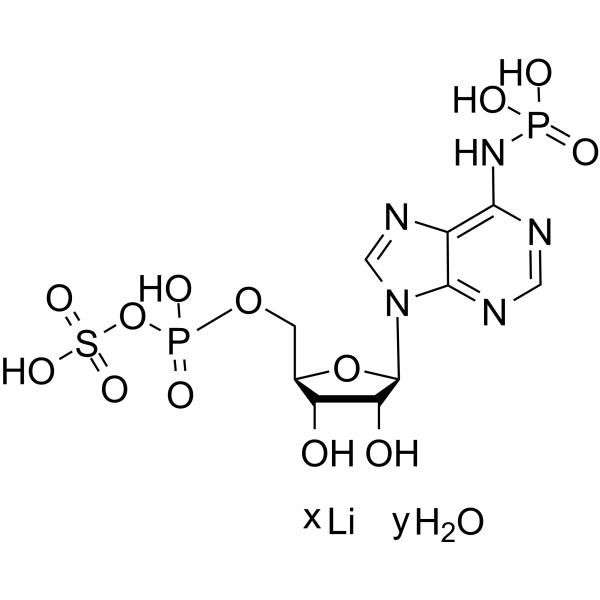 0 ImagesCat. No.: HY-W250153AAdenosine 3'-phosphate 5'-phosphosulfate lithium hydrate, an adenine nucleotide derivative, is a selective P2Y1 antagonist with no effect on P2Y2, P2Y4, or P2Y6 receptors. Adenosine 3'-phosphate 5'-phosphosulfate lithium hydrate can competitive inhibit ADP-induced platelet aggregation, as well as the ability of ADP to cause shape change and increases in Ca2+ in platelets, but had no effect on the inhibition of stimulated adenylate cyclase by ADP. Adenosine 3'-phosphate 5'-phosphosulfate lithium hydrate is a co-substrate used for the sulfonation of glycans. Adenosine 3'-phosphate 5'-phosphosulfate lithium hydrate can be used for Golgi-resident PAP-specific 3'-phosphatase-coupled sulfotransferase assays, which as donor substrate to transfer a sulfonate group.
-
Sp-UTP-α-S tetrasodium
 0 ImagesCat. No.: HY-137612ASynonyms: Uridine 5'-O-1-thiotriphosphate tetrasodiumSp-UTP-α-S (Uridine 5-0-1-thiotrirhosphate) tetrasodium is a P2Y2 and P2Y4 receptor activator. Sp-UTP-α-S tetrasodium can be used in cancer research.
-
Prasugrel-d5
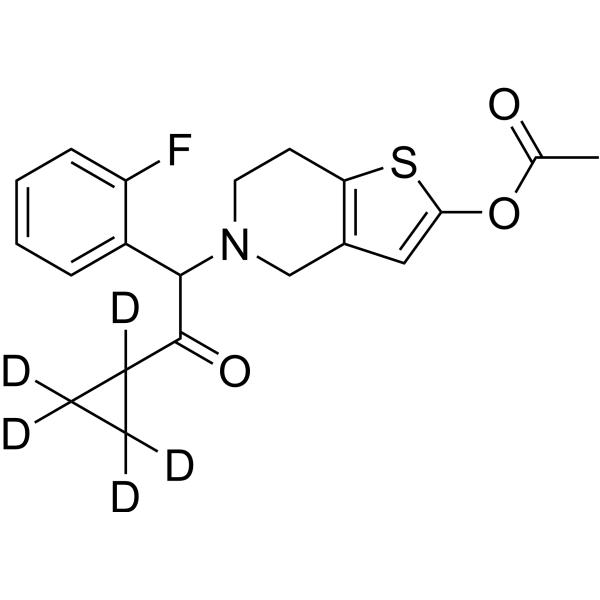 0 ImagesCat. No.: HY-15284SCAS No.: 1127252-92-9Synonyms: PCR 4099-d5Prasugrel-d5 is deuterium labeled Prasugrel. Prasugrel (PCR 4099), a thienopyridine and prodrug, inhibits platelet function. Prasugrel is an orally active and potent P2Y12 receptor antagonist, and inhibits ADP-induced platelet aggregation.
-
P2RY14 Human Pre-designed siRNA Set A
 0 ImagesCat. No.: HY-RS09925
P2RY14 Human Pre-designed siRNA Set A contains three designed siRNAs for P2RY14 gene (Human), as well as a negative control, a positive control, and a FAM-labeled negative control.
-
Diquafosol
 0 ImagesCat. No.: HY-B0606ACAS No.: 59985-21-6Synonyms: INS365 free baseDiquafosol (INS365 free base) is a potent P2Y2 agonist. Diquafosol nhibits apoptosis and decreases ROS generation. Diquafosol has the potential for the research of dry eye.
-
P2ry4 Rat Pre-designed siRNA Set A
 0 ImagesCat. No.: HY-RS09933
P2ry4 Rat Pre-designed siRNA Set A contains three designed siRNAs for P2ry4 gene (Rat), as well as a negative control, a positive control, and a FAM-labeled negative control.
-
MRS4865
 0 ImagesCat. No.: HY-168139CAS No.: 2801624-14-4MRS4865 (compund 7a) is a chimera of a P2Y14 receptor antagonist and a UDP-glucose agonist that protects against neuropathic pain.
-
P2Y14R antagonist 3
 0 ImagesCat. No.: HY-172226P2Y14R antagonist 3 (Compound A) is a potent and orally active P2Y14R antagonist with an IC50 value of 23.60 nM and a Kd value of 7.26 μM. P2Y14R antagonist 3 can reduce the degree of lung injury in the Lipopolysaccharides (LPS) (HY-D1056)-induced acute lung injury mice. P2Y14R antagonist 3 can be used for inflammatory diseases.
-
PPTN mesylate
 0 ImagesCat. No.: HY-103055CAS No.: 1160271-31-7PPTN mesylate is a potent, high-affinity, competitive and highly selective P2Y14 receptor antagonist with a KB value of 434 pM. PPTN mesylate exhibits no agonist or antagonist effect at the P2Y1, P2Y2, P2Y4, P2Y6, P2Y11, P2Y12, or P2Y13 receptors. Anti-inflammatory and immune activity.




